
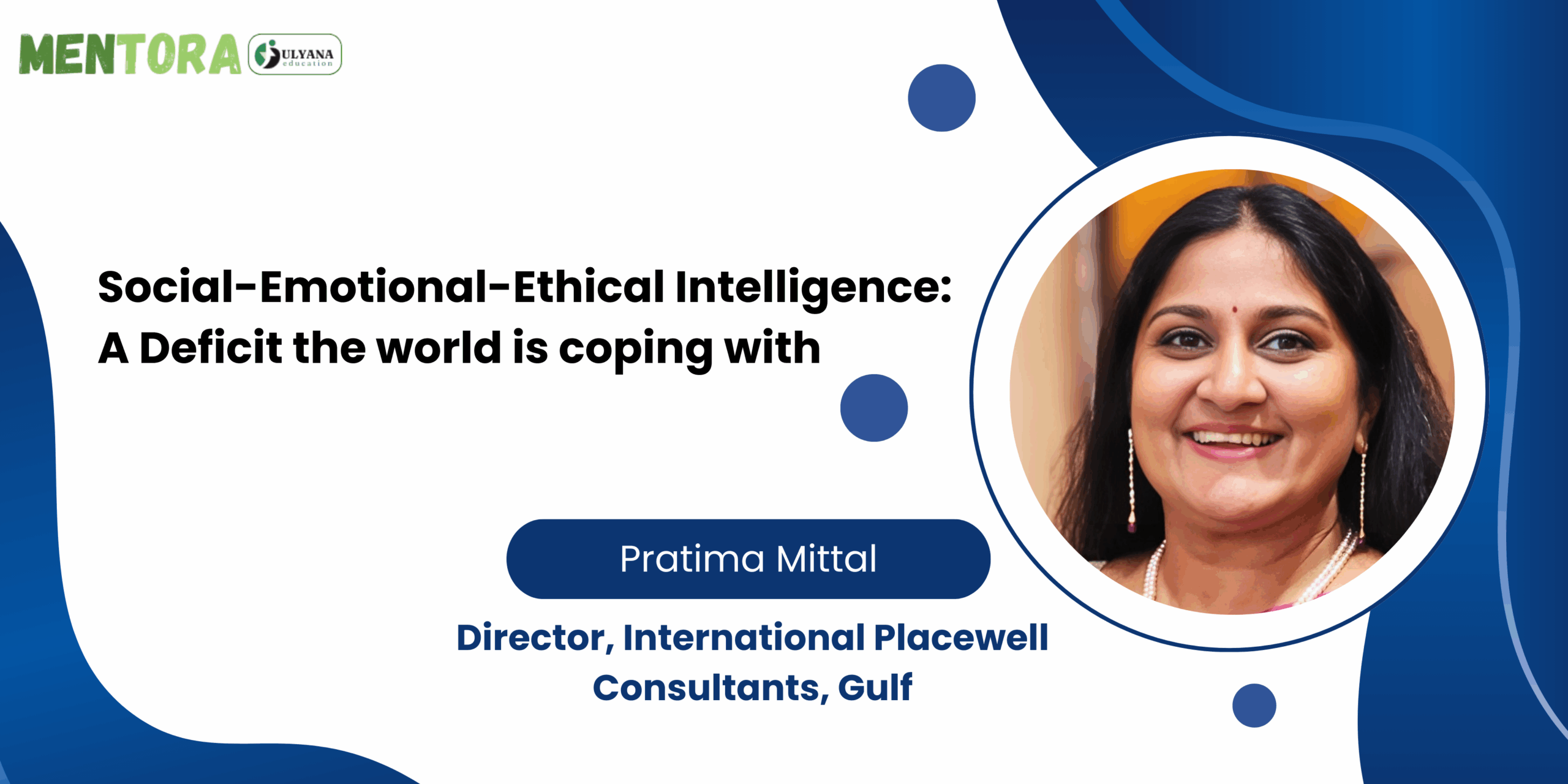
SOCIAL-EMOTIONAL-ETHICAL INTELLIGENCE: A DEFICIT THE WORLD IS COPING WITH
‘In a shocking incident, a female student in an Andhra Pradesh college hit a woman lecturer with her footwear for confiscating her mobile phone’
‘A 17-year-old boy leaped off the fourth floor of his apartment after being bullied by his classmates, police said on Wednesday’
‘Tamil Nadu shocker: Class 12 boy beaten to death by classmates for talking to girls; probe on’
We often wake up to heartbreaking news highlighting tragedies, drawing attention to the concerning state of mind in which we find ourselves. As onlookers, we merely comment, discuss, and empathize with these situations.
“What is this world coming to?” or “What is the government doing about this?” and “The entire education system is flawed”; do these phrases sound familiar?
MY QUESTION TO YOU IS SIMPLE: WHO IS RESPONSIBLE TO BEGIN THESE CHANGES?
If you are affected by these mindless and tragic incidents, is it not your duty to take action, to do something— anything? Is it not time to reflect on what we have lost as a society, as a country, and as human beings that leads to such tragedies?
For years, we have prioritized Intelligence Quotient (IQ).It is only recently that the world is gradually recognizing the importance of Social-Emotional Intelligence as an important skill for success in life. The World Economic Forum identifies social-emotional intelligence as a core set of skills for the future, alongside technical skills. UNESCO advocates for integrating SEL across all levels of education, from early childhood to higher education, due to its positive effects on academic performance, social behavior, and overall well-being.
WHAT IS SOCIAL EMOTIONAL INTELLIGENCE?
Social and emotional intelligence (SEI) refers to the ability to understand, use, and manage one’s own emotions and the emotions of others. It is a holistic process of learning grounded in ethics of care that links the cognitive with the social and emotional as well as relational aspects of learning toward supporting learners’ well-being, academic attainment, and active global citizenship for positive social change.
Peter Salovey and John D. Mayer are credited for first exploring and defining EI. They explained EI as “the ability to monitor one’s own and others’ feelings and emotions’. Daniel Goleman popularized emotional intelligence theory which outlines five components of EI: self-awareness, self-regulation, motivation, empathy, and social skills.
The Principles of The National Education Policy (NEP2020) states as follows ‘The purpose of the education system is to develop good human beings capable of rational thought and action, possessing compassion and empathy, courage and resilience, scientific temper and creative imagination, with sound ethical moorings and values.’

Today exists several working models that highlight the needs and competencies to develop Social-emotional- Ethical Learning and leadership.
The CASEL Framework defines social and emotional learning (SEL) as an integral part of education and human development. SEL is the process through which all young people and adults acquire and apply the knowledge, skills, and attitudes to develop healthy identities, manage emotions and achieve personal and collective goals, feel and show empathy for others, establish and maintain supportive relationships, and make responsible and caring decisions.
The EMC2 model, developed by UNESCO MGIEP, is a framework that focuses on four key competencies: Empathy, Mindfulness, Compassion, and Critical Inquiry.
Emory University in association with His Holiness the Dalai Lama in 1998, added an element of ethics to emanate a comprehensive model of Social-Emotional- Ethical learning. Guided by a shared vision for an education of heart and mind, it conveys a universal, non- sectarian, and science-based approach to bringing the ethical development of the whole child into education.

IS SEEL THE MAGIC SPELL NEEDED FOR CONFLICT RESOLUTION?
Developing SEEL (Social, Emotional, and Ethical Learning) competencies has proven to be beneficial in several ways:
1. De-escalating Aggression and Intolerance: These competencies help cultivate patience, tolerance, and empathy, which can reduce instances of impulsive behaviour.
2. Addressing Mental Health Crises: By building emotional literacy and effective coping mechanisms, SEEL can help prevent chronic depression and anxiety, promoting overall psychological well-being.
3. Creating a Safe Environment: Encouraging positive social skills and empathy fosters a positive school environment, characterized by holistic growth.
4. Decreasing Digital Distractions and Disconnection: Rebuilding genuine relationships through active listening, compassion, and mindful interaction helps combat the negative effects of technology-related disconnection.
5. Eliminating Ethical Ambiguities: Establishing ethical and acceptable frameworks for reflective decision- making rooted in universal human values can guide individuals in making clearer and more responsible choices.
IS SEEL A MAGIC SPELL THAT HAS RECENTLY BEEN DEVELOPED?
Emotional intelligence is deeply rooted in Indian philosophy, with the Bhagavad Gita serving as a key source of wisdom on understanding and managing emotions and finding a path out of emotional instability. It emphasizes the importance of equanimity, which involves maintaining mental equilibrium and emotional balance regardless of external circumstances. It offers profound insights into emotional intelligence and encourages individuals to attain a state of ‘Sthitaprajna’ (T�तप्रज्ञ) – one with steady wisdom.
Bhagvat Gita Chapter 2, verse 15 suggests that a person who is calm and unaffected by both happiness and sorrow is on the path to liberation.
यं ह न व्यथयन्तयेते पुरुषं पुरुषष भ |
सम ःखसुखं धीर सोऽमृतत्वाय कल्पते ||
There is sensibility and intelligence in making Social- Emotional-Ethical Learning (SEEL) a part of the learning system in schools. According to a study by CASEL a $1 investment in quality SEL programs is estimated to yield an $11 return which is further highlighted in the Economic Survey of India 2024-25.
Despite substantial evidence highlighting the role of emotional intelligence in achieving success both academic and professional, this essential quality is rapidly diminishing. There is a profound truth is Barack Obama’s statement, “the empathy deficit is a more pressing political problem for America than the federal deficit”.
We can question the impact, the concepts and debate the origins of the idea, but we cannot ignore the fact that the world is experiencing a resurgence of various forms of conflict and violence, including racism, discrimination, hate speech, and armed conflicts.
Amidst this chaos, there is an urgent need for tools to peacefully, amicably, and intelligently mitigate these conflicts.
What could be these tools be?
Could Social-Emotional-Ethical Intelligence be an answer?

Originally featured in Mentora Magazine (August 2025 Edition), this article by Pratima Mittal explores the growing deficit of social, emotional, and ethical intelligence in today’s world — and why SEEL education is essential for our future.
Published in Mentora Magazine – August 2025 Edition | Ulyana Education.
