
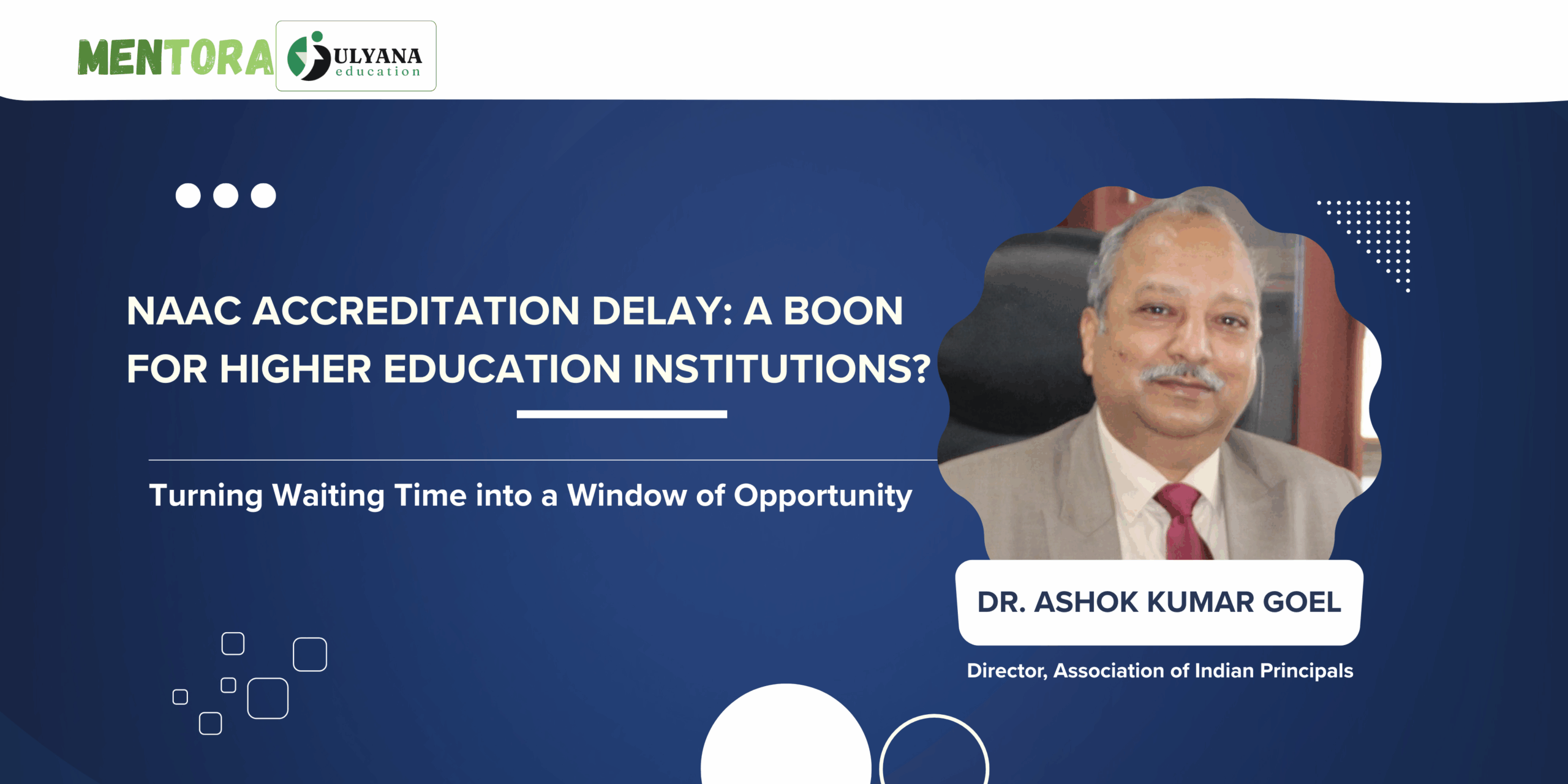
NAAC ACCREDITATION DELAY: A BOON FOR HIGHER EDUCATION INSTITUTIONS?
TURNING WAITING TIME INTO A WINDOW OF OPPORTUNITY
The recent delay in the release of revised accreditation guidelines by the National Assessment and Accreditation Council (NAAC) has stirred considerable discussion within India’s higher education circles. While the absence of updated norms creates temporary ambiguity, it also presents a unique opportunity for institutions to regroup, reassess, and reinforce their internal systems. Rather than viewing the delay as a disruption, it may well be a timely boon—if approached strategically.
Accreditation is a vital process for institutions of higher education, serving as a formal recognition of quality, accountability, and continuous improvement. NAAC, being a premier accreditation body, is expected to realign its guidelines with the National Education Policy (NEP) 2020, which emphasizes outcome-based education, digital learning, research excellence, and institutional autonomy. The forthcoming guidelines are anticipated to be more rigorous, data-driven, and focused on long-term impact rather than short-term compliance.
For institutions that are yet to undergo assessment or are gearing up for re-accreditation, the current pause offers a valuable window for internal strengthening. Rather than rushing through documentation and last- minute data collation, institutions can take a more thoughtful and deliberate approach to quality enhancement.

HERE’S HOW INSTITUTIONS CAN BENEFIT DURING THIS INTERLUDE:
- Revamping Internal Quality Assurance (IQA): Many institutions still treat accreditation as a one- time exercise rather than a culture. This delay allows the Internal Quality Assurance Cells (IQACs) to institutionalize periodic reviews, conduct internal academic audits, and implement data management systems aligned with expected NAAC metrics.
- Faculty Capacity Building: With anticipated changes in the weightage given to teaching- learning processes, research, and innovation, this period is ideal for faculty development. Institutions can organize workshops, training programs, and collaborative learning opportunities to build competence in areas such as OBE (Outcome-Based Education), curriculum design, ICT integration, and research methodology.
- Data Collection and Management: One of the key challenges in NAAC accreditation is robust and verifiable data. Institutions can now refine their data governance processes, improve MIS systems, and ensure accuracy in Student Satisfaction Surveys (SSS), alumni tracking, and placement records.
- Policy Reforms and Stakeholder Engagement: Institutions can review and upgrade their policies related to inclusivity, sustainability, ethics, and community engagement. They can also conduct awareness programs to engage students, alumni, employers, and parents, thus enriching their feedback mechanisms.
- Strategic Planning and Visioning: The delay provides time to align institutional goals with NEP 2020, draft realistic strategic plans, and identify gaps in infrastructure, faculty recruitment, or industry collaboration that need to be bridged before the new guidelines come into effect.
This waiting period also underscores a crucial lesson: the focus must shift from accreditation for certification to accreditation for transformation. Institutions that adopt a proactive mindset will not only be ready when the new guidelines are launched, but will also be better positioned to deliver meaningful education outcomes.
In conclusion, the delay in NAAC’s revised guidelines need not be a cause for concern. For forward-looking institutions, it is a golden opportunity—a chance to innovate, introspect, and improve. The key lies in using this time wisely, with purpose and vision.
Originally featured in Mentora Magazine (August 2025 Edition), this article was written by Dr. Ashok Kumar Goel. It discusses how the delay in the revised NAAC accreditation guidelines can serve as a strategic opportunity for higher education institutions to strengthen internal quality systems, enhance faculty capacity, improve data governance, and align institutional practices with NEP 2020 for meaningful and sustainable transformation.
Published in Mentora Magazine – August 2025 Edition | Ulyana Education.
